
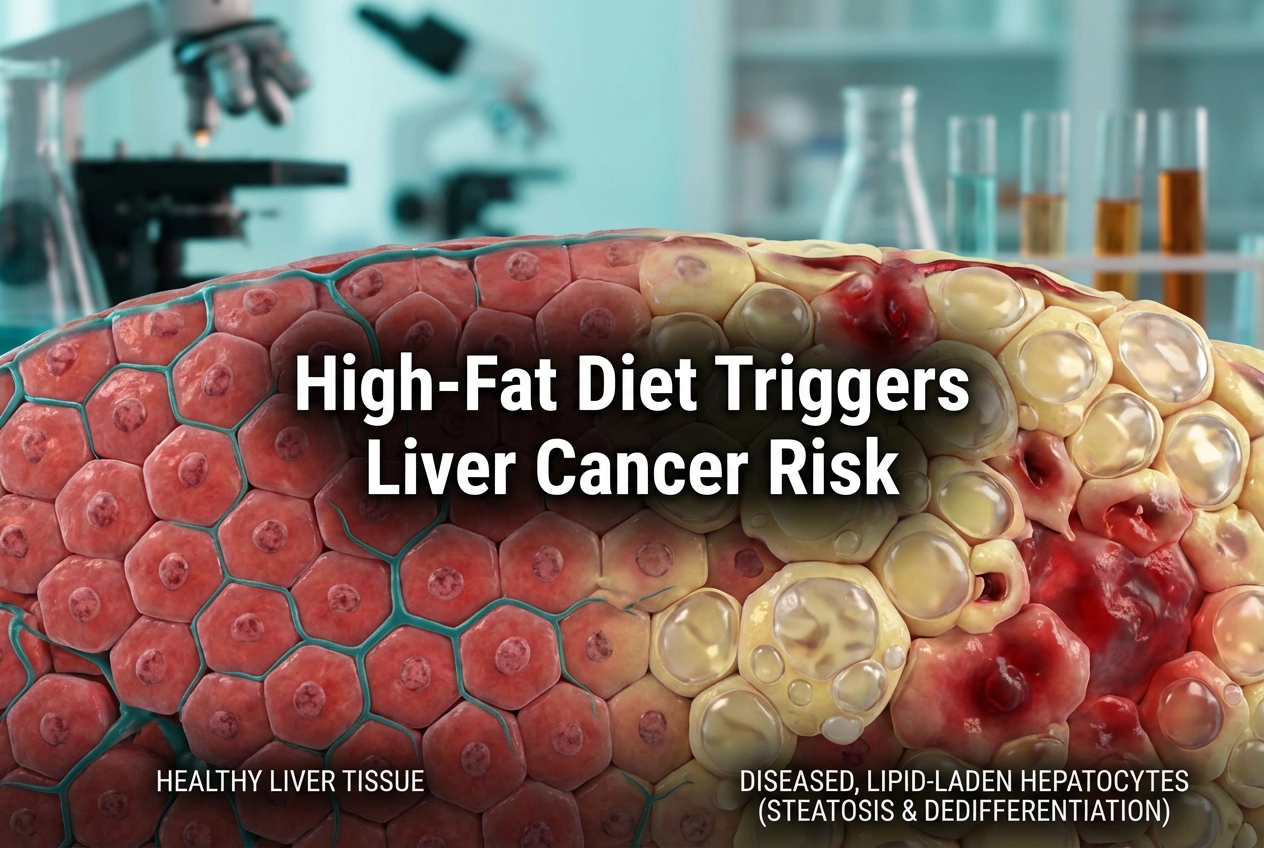
A high-fat diet causes more than just fat overload in the liver. New research from MIT has unveiled a cellular mechanism that quietly raises the risk of liver cancer. Researchers found that prolonged metabolic stress pushes mature liver cells, called hepatocytes, into a survival mode, forcing them into a reversion to an immature state (Hepatocyte Dedifferentiation). Consequently, this shift leaves the liver far more vulnerable to tumor formation, thus explaining why fatty liver disease often precedes liver cancer. This groundbreaking study fundamentally alters how scientists understand the link between diet and tumorigenesis. If you are interested in deeper study on advanced disease mechanisms, consider the Postgraduate Diploma In Cancer And Molecular Pathology And Genomics.
The Dangerous Trade-Off of Hepatocyte Dedifferentiation
When the liver is repeatedly exposed to a high-fat diet, specialized hepatocytes undergo a major transformation. Instead of performing their normal metabolic roles, these cells revert to a more primitive, stem-cell-like state. Although this transformation allows them to better withstand the harsh stress caused by excess fat, it also drastically increases their susceptibility to becoming cancerous over time. The researchers describe this as a trade-off. In other words, the individual cell prioritizes its own survival at the expense of the collective tissue’s function. Gene-sequencing showed that genes essential for normal function—like those for metabolism and protein secretion—were gradually shut down. Simultaneously, the cells began activating genes that promote cell survival and continued growth. Therefore, the tissue becomes less functional and more vulnerable to malignancy.
Primitive Cells: A Head Start for Cancer
The key danger lies in the characteristics of these primitive cells. When liver cells exist in a less mature state, they are far more likely to become cancerous if a damaging mutation occurs later. Significantly, these cells have already activated the same genes that are necessary for cancer development. As a result, they have lost the mature identity that would otherwise hinder their ability to proliferate. Once a cell acquires an oncogenic mutation, the process accelerates because the cell already possesses a "head start" on the hallmarks of cancer. Furthermore, the research highlighted that patients with higher expression of these pro-survival genes—activated by the high-fat diet—experienced a shorter survival time after tumors developed. Conversely, a lower expression of normal liver function genes also predicted poorer patient outcomes. For professionals focused on malignancy, the Certification Course In Clinical Oncology offers relevant insights.
Identifying Molecular Targets for Intervention
The research team identified several transcription factors that regulate this cellular shift. These factors may serve as crucial new targets for drugs designed to reduce cancer risk. Specifically, a drug targeting one identified factor (thyroid hormone receptor) has already received approval for a severe form of steatotic liver disease known as MASH fibrosis. Additionally, a drug that activates another enzyme identified in the study (HMGCS2) is currently in clinical trials for steatotic liver disease. Another promising target uncovered by the research is the transcription factor SOX4. This factor is typically active only during fetal development or in limited adult tissues, making its activation in adult liver cells particularly notable. Ultimately, the researchers aim to test whether lifestyle changes, such as returning to a healthier diet, or the use of weight-loss medications (like GLP-1 agonists), can reverse the cellular changes and restore normal hepatocyte behavior. Understanding metabolic drivers is key, making the Postgraduate Diploma In Diabetes a related area of study.
Frequently Asked Questions
Q1: What is the main mechanism linking a high-fat diet to liver cancer?
The primary mechanism is the stress-induced reversion of mature liver cells (hepatocytes) to a primitive, stem-cell-like state, a process known as Hepatocyte Dedifferentiation. This shift turns off normal liver functions while activating pro-survival and pro-growth genes, thus giving cancer a dangerous head start.
Q2: Did the researchers only study this effect in mice?
No. While the initial study was performed using mice fed a high-fat diet, the researchers confirmed their findings by analyzing liver tissue samples from human patients with steatotic liver disease. The human samples showed the same pattern of declining normal liver genes and increasing immature cell-state genes.
Q3: Can the damage caused by a high-fat diet be reversed?
The research team is currently planning studies to address this question. Future work will investigate whether returning to a healthier diet or using weight-loss medications, such as GLP-1 agonists, can successfully reverse the cellular changes and restore normal liver cell function. Exploring metabolic health is crucial, which relates to the International Post Graduate Program In Diabetes Mellitus Management.
References
- Study shows high-fat diets give liver cancer a dangerous head start – ETHealthworld
- MIT study shows high-fat diets give liver cancer a dangerous head start – ScienceDaily.
- High-fat diets make liver cells more likely to become cancerous – Broad Institute.
- Implication of hepatocyte dedifferentiation in pathogenesis and treatment of hepatocellular carcinoma – Precision and Future Medicine.
- MIT Reveals How High-Fat Diets Quietly Prime the Liver for Cancer – SciTechDaily.
- High-Fat Diets Linked to Increased Liver Cancer Risk Through Cellular Changes.
- Dedifferentiation of hepatocellular carcinoma: molecular mechanisms and therapeutic implications – PubMed.
- Implication of hepatocyte dedifferentiation in pathogenesis and treatment of hepatocellular carcinoma – Precision and Future Medicine.
- Study finds fatty diets reprogram liver cells, raising cancer risk – YouTube.
Disclaimer: This article was automatically generated from publicly available sources and is provided for informational and educational purposes only. OC Academy does not exercise editorial control or claim authorship over this content. It is not a substitute for professional medical advice, diagnosis, or treatment. Always consult a qualified healthcare provider and refer to current local and national clinical guidelines.