Why Over 1,000 Govt MBBS Seats Open Too Late for Merit
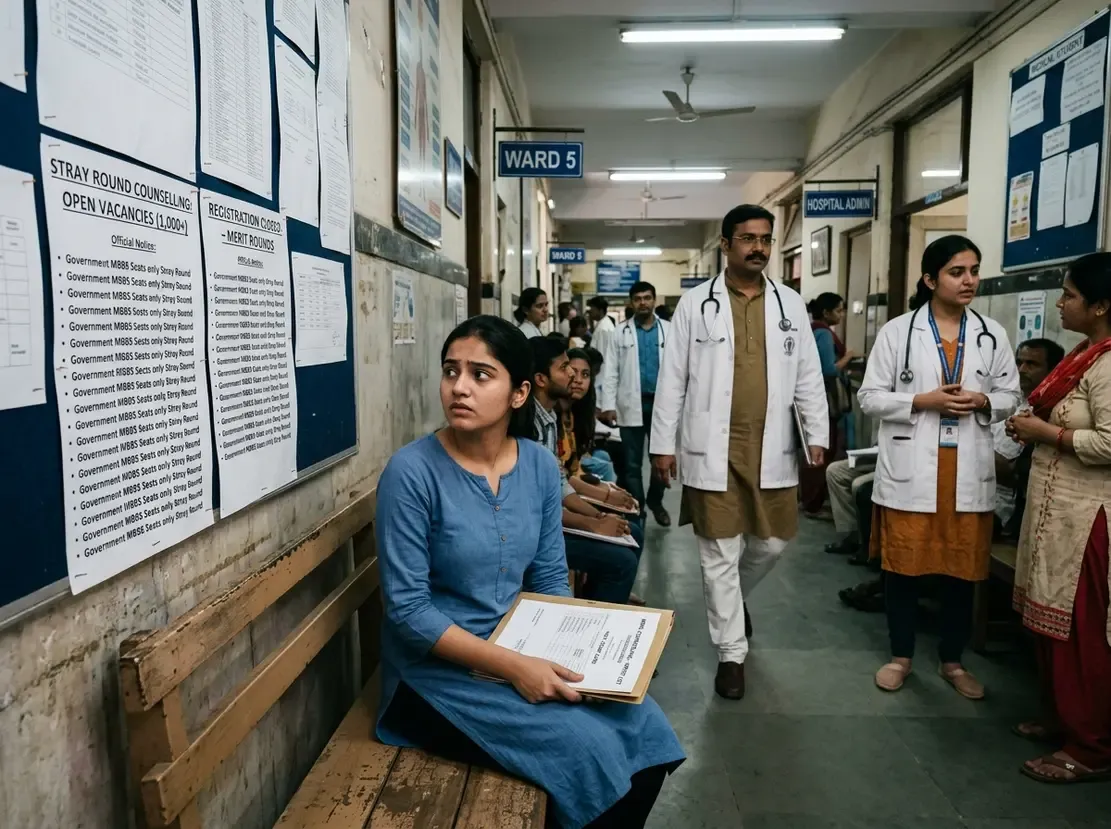
Persistent loopholes in the medical admission process allow candidates to hold multiple allotments across state and central quotas. Consequently, widespread MBBS seat blocking has pushed more than 2,000 medical seats into the stray vacancy round across India. Over 1,000 of these vacant positions belong to state and central government colleges. Furthermore, this structural flaw prevents higher-scoring NEET candidates from claiming heavily subsidised government seats during standard allotment rounds.
How Counselling Gaps Drive MBBS Seat Blocking
The Medical Counselling Committee released a 272-page list of candidates who failed to report after round three. These candidates missed their mandatory reporting deadline. However, existing counselling regulations permit candidates to decline a newly upgraded allotment while retaining an earlier seat. For example, a student admitted through state counselling can secure an All India Quota seat and simply decline it. Because state and central portals operate independently, the system fails to cancel the previous admission automatically. In addition, nominal penalties ranging between 5,000 and 10,000 rupees offer little deterrent against seat hoovering. Therefore, high-value seats remain occupied on paper until regular counselling closes completely.
Severe Financial Strain on High-Ranking Applicants
This regulatory delay creates severe financial distress for meritorious students and their families. Many high-scoring candidates accept private medical college seats during the second or third rounds to avoid losing an academic year. These private colleges frequently charge annual tuition fees of 23 to 30 lakh rupees. Subsequently, prime government seats emerge during the final stray vacancy round. Crucially, counselling regulations strictly prohibit already admitted students from upgrading their seats in stray rounds. Consequently, lower-ranked candidates secure government seats at a fraction of the cost. Meanwhile, higher-ranked candidates remain trapped in expensive private institutions, while others explore professional development like clinical training programs to bridge their transition into practice.
Urgent Regulatory Reforms Proposed by Experts
Medical education experts and student counsellors demand comprehensive systemic overhauls. First, authorities must deploy a unified digital dashboard linking state and central counselling platforms before the third round. Furthermore, the system should instantly cancel an existing seat whenever an applicant accepts an upgraded offer. Counsellors also recommend imposing a mandatory one-year debarment from NEET for candidates who abandon allotted government seats. Moreover, regulatory bodies should permit upward mobility during stray rounds to restore fairness. In conclusion, synchronised admission timelines will protect deserving applicants and uphold medical meritocracy.
Frequently Asked Questions
Q1: Why do government MBBS seats remain vacant until the stray round?
Candidates often secure seats across both state and central quotas simultaneously. When they decline central allotments late, those vacant seats shift directly into the final stray vacancy round.
Q2: Can students admitted to private colleges upgrade in the stray round?
No, counselling regulations strictly prohibit candidates with joined seats from participating in stray vacancy rounds. Therefore, students already enrolled in private institutions cannot upgrade to newly vacant government seats.
Q3: What reforms can eliminate seat blocking in NEET counselling?
Experts recommend a unified software dashboard across state and central authorities, automatic seat cancellation upon fresh allotment, and strict one-year debarment penalties for unjustified seat refusal. Aspirants preparing for entrance assessments can also utilize resources such as a free NEET PG mock test to gauge their exam readiness.
References
- Over 1,000 MBBS seats in govt colleges open up too late for higher scorers - ETHealthworld
- Medical Counselling Committee (MCC), Directorate General of Health Services. NEET UG Counselling Scheme and Guidelines.
- Supreme Court of India. Directives on Anti-Seat Blocking and Stray Vacancy Allotment in Medical Admissions.