
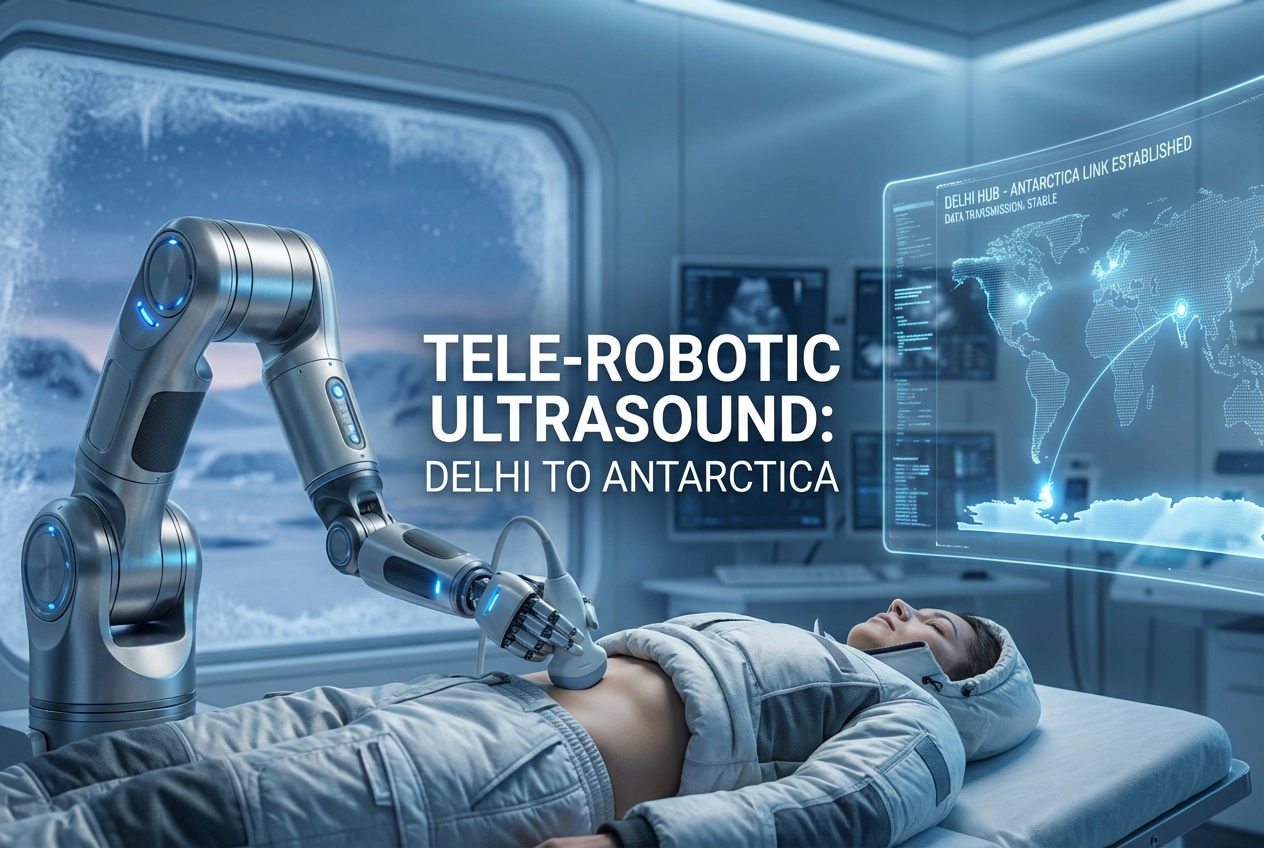
India recently reached a significant milestone in digital health. Researchers successfully demonstrated Tele-robotic Ultrasonography connecting Delhi to Antarctica. This breakthrough bridges a geographical gap of 12,000 kilometers. Furthermore, Union Minister Jitendra Singh noted that this technology adds a new dimension to remote care. He witnessed the system linking AIIMS New Delhi with India’s Maitri Research Station. Specifically, a radiologist in Delhi conducted a real-time examination on a volunteer at the Antarctic base. This innovation reflects the convergence of AI and robotics. Additionally, it expands the reach of specialist healthcare beyond geographical barriers. Those interested in the cutting edge of Radiology Speciality Courses will find this fascinating.
The Mechanics of Tele-robotic Ultrasonography
AIIMS New Delhi and IIT Delhi developed this system in collaboration with NCPOR. The core component is a robotic arm featuring six degrees of freedom. This arm replicates the precise hand movements of an expert sonographer. Moreover, the system includes force-sensing safety features to protect patients. It delivers reliable diagnostic imaging with less than a one-second delay. Consequently, clinicians can perform emergency-focused assessments remotely. These include FAST scans, cardiac assessments, and trauma screenings. Therefore, the technology proves effective even in high-stress medical situations, underscoring the need for expertise in Certification Course In Emergency Medicine.
Bridging the Global Healthcare Divide
Engineers designed the technology for extreme and remote environments. In Antarctica, medical evacuation is often complex and expensive. Consequently, this system supports critical decision-making regarding local treatment versus evacuation. Furthermore, Minister Singh emphasized that the innovation embodies a whole-of-science approach. It brings together diverse institutions for a common national purpose. Additionally, these emerging technologies can bridge the rural-urban healthcare divide in India. The system’s affordability and robustness make it suitable for disaster zones. Thus, India continues its march toward becoming a science-powered developed nation, benefiting from advancements relevant to Foundation Comprehensive Training For New Doctor programs.
Frequently Asked Questions
Q1: How does the robotic arm ensure patient safety during a remote scan?
The robotic arm features advanced force-sensing safety mechanisms. These sensors allow the remote doctor to feel the pressure applied, which prevents injury and ensures diagnostic accuracy.
Q2: Can this system be used in areas other than Antarctica?
Yes, researchers designed the system for broad scalability. It is suitable for deployment in rural health centers, border areas, disaster zones, and mobile medical units across India.
References
- AI-powered tele-robotic ultrasound links Delhi to Antarctica, heralds new era inremote healthcare – ETHealthworld
- Advancing Healthcare Frontiers: India demonstrates Tele-Robotic Ultrasound connecting AIIMS New Delhi with Maitri Research Station in Antarctica – PIB
- AIIMS Delhi doctors conduct remote ultrasound scan on man in Antarctica – Hindustan Times
Disclaimer: This article was automatically generated from publicly available sources and is provided for informational and educational purposes only. OC Academy does not exercise editorial control or claim authorship over this content. It is not a substitute for professional medical advice, diagnosis, or treatment. Always consult a qualified healthcare provider and refer to current local and national clinical guidelines.