
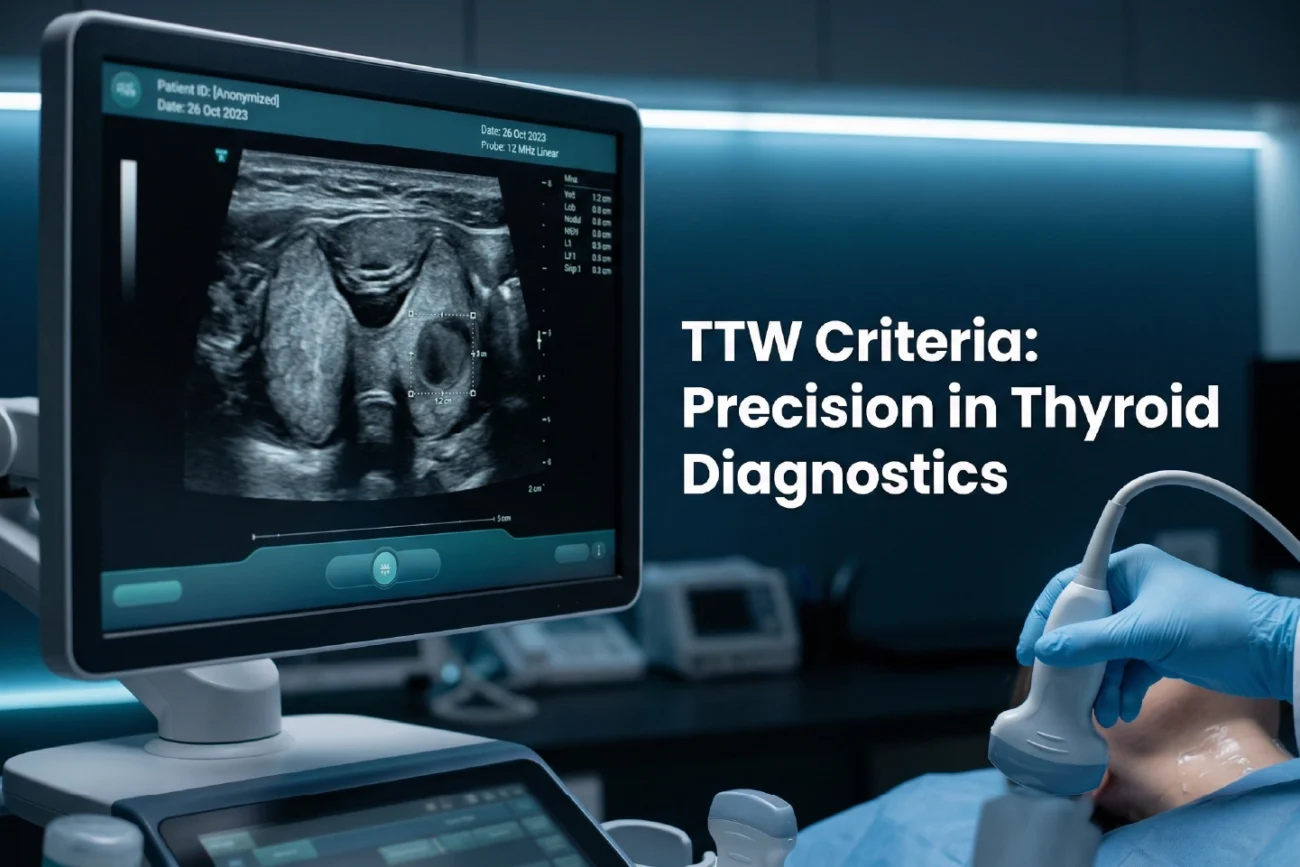
Clinicians in India often face the challenge of managing common thyroid nodules while avoiding over-treatment. Consequently, applying precise thyroid nodule TTW criteria during ultrasound becomes essential for accurate risk stratification. A taller-than-wide (TTW) shape serves as a powerful indicator of malignancy, yet the optimal plane for measurement has long been debated. This recent comparative analysis across major TIRADS versions provides much-needed clarity for modern practice.
The Superiority of Dual-Plane Thyroid Nodule TTW Criteria
The study retrospectively reviewed 1125 thyroid nodules to compare different measurement approaches. Researchers evaluated transverse-only, longitudinal-only, and dual-plane criteria across four major reporting systems. Interestingly, assessing the TTW shape in both planes achieved the highest accuracy for C-TIRADS and EU-TIRADS. Furthermore, this dual-plane method significantly improved the reclassification of nodules for malignancy prediction. By adopting a stricter measurement standard, radiologists can better distinguish suspicious lesions from benign ones.
Optimizing Fine-Needle Aspiration Guidance
Effective biopsy decisions rely on clear imaging markers to reduce unnecessary procedures. For FNA guidance, the dual-plane criterion showed notable improvements in ACR-TIRADS and C-TIRADS. This finding aligns with the goals of the Endocrine Society of India to minimize incidentaloma interventions. Moreover, standardizing these ultrasound evaluations ensures consistent results across different clinical settings. Therefore, implementing dual-plane assessments helps streamline the diagnostic pathway for patients with thyroid concerns.
Frequently Asked Questions
Q1: Why is the dual-plane measurement more accurate than the transverse-only method?
Measuring in both planes ensures a comprehensive evaluation of the nodule’s growth orientation. This stricter requirement helps filter out benign nodules that might appear taller only in one specific cross-section.
Q2: How does this research benefit clinical practice in India?
In India, where thyroid nodules are highly prevalent, these refined criteria help doctors avoid unnecessary fine-needle aspirations. Consequently, it reduces the patient burden and focuses resources on high-risk cases that truly require intervention.
References
- Zhuang Y et al. Dual-plane taller-than-wide definition for thyroid nodules: comparative analysis across TIRADS. Eur Radiol. 2026 Feb 28. doi: 10.1007/s00330-026-12389-8. PMID: 41762261.
- Tessler FN et al. ACR Thyroid Imaging, Reporting and Data System (TI-RADS): White Paper of the ACR TI-RADS Committee. J Am Coll Radiol. 2017;14(5):587-595.
- Endocrine Society of India. Management guidelines for patients with thyroid nodules: A position statement. Indian J Endocrinol Metab. 2011;15(1):2-8.