Photon-Counting CTPA: Lower Radiation and Contrast Dose
Advantages of Photon-Counting Detector CT in CTPA
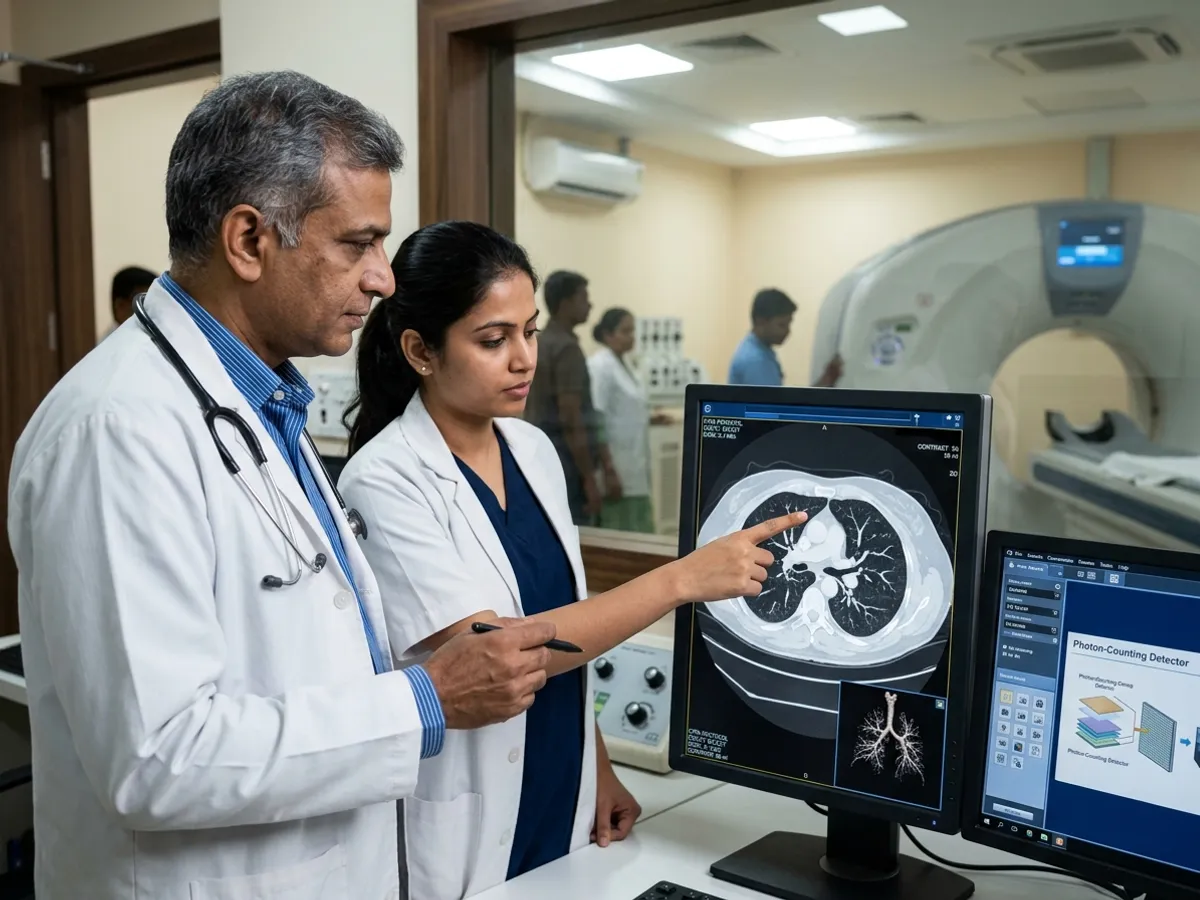
Computed tomography pulmonary angiography remains the definitive standard for detecting acute pulmonary embolism. However, conventional energy-integrating detector systems often require substantial radiation exposure and iodinated contrast media. Emerging evidence indicates that photon-counting detector CT substantially transforms CT pulmonary angiography protocols by optimizing diagnostic efficacy.
Significant Dose and Contrast Reduction
Recent meta-analytic evidence shows that photon-counting systems deliver meaningful reductions in both radiation exposure and contrast material. Specifically, pooled analyses reveal a significant reduction in the volume CT dose index compared to conventional scanners. Furthermore, patients receive a notably lower total iodine load without compromising vascular enhancement. Consequently, these advances minimize the risk of contrast-induced nephropathy in vulnerable patients.
Preserving Diagnostic Accuracy and Image Quality
In addition to safety gains, spectral reconstructions maintain superior vascular visualization. For example, virtual monoenergetic imaging enhances iodine signal attenuation at low energy levels. Therefore, clinicians obtain high signal-to-noise and contrast-to-noise ratios despite reduced contrast volumes. Moreover, sharp spatial resolution allows confident identification of subtle peripheral and subsegmental filling defects through advanced thoracic & respiratory radiology principles.
Clinical Implications for Pulmonary Embolism
Consequently, adopting these next-generation scanners benefits high-risk populations, including pregnant individuals and patients with baseline renal impairment. Additionally, rapid high-pitch scanning decreases motion artifacts from dyspneic patients during acute presentations. Thus, modern emergency departments can expedite accurate clinical decision-making while upholding strict radiation safety standards.
Frequently Asked Questions
Q1: How does photon-counting detector CT lower radiation dose during CTPA?
Direct conversion detectors eliminate electronic noise and maximize photon energy utilization. As a result, diagnostic imaging requires lower overall radiation exposure.
Q2: Why can contrast volume be reduced with this technology?
Low-kiloelectronvolt virtual monoenergetic reconstructions boost iodine attenuation significantly. Therefore, radiologists achieve robust arterial opacification with smaller volumes of contrast media.
Q3: Does dose reduction compromise the detection of peripheral pulmonary emboli?
No, the ultra-high spatial resolution maintains excellent image clarity. Consequently, visualization of small subsegmental pulmonary arteries remains highly accurate.
References
- Kato S et al. Photon-counting detector CT for CT pulmonary angiography: a systematic review and meta-analysis. Eur Radiol. 2026 Aug 24. doi: 10.1007/s00330-026-12829-5. PMID: 42635786.
- Euler A et al. Reducing contrast media dosage for pulmonary embolism CTPA in PCD-CT: a comparative study of EID-CT and PCD-CT in the era of individualized protocolling. Eur Radiol. 2026.
- Remy-Jardin M et al. Minimizing contrast media dose in CT pulmonary angiography with clinical photon counting using high pitch technique. Acad Radiol. 2024;31(2):686-692.